AI Signals Report — Local agents, provenance, and control planes
Capability is becoming cheap and portable across hosted and self-hosted stacks. The differentiator is now execution governance: proving what an agent was allowed to do, what it did, and how it can be stopped or reversed.
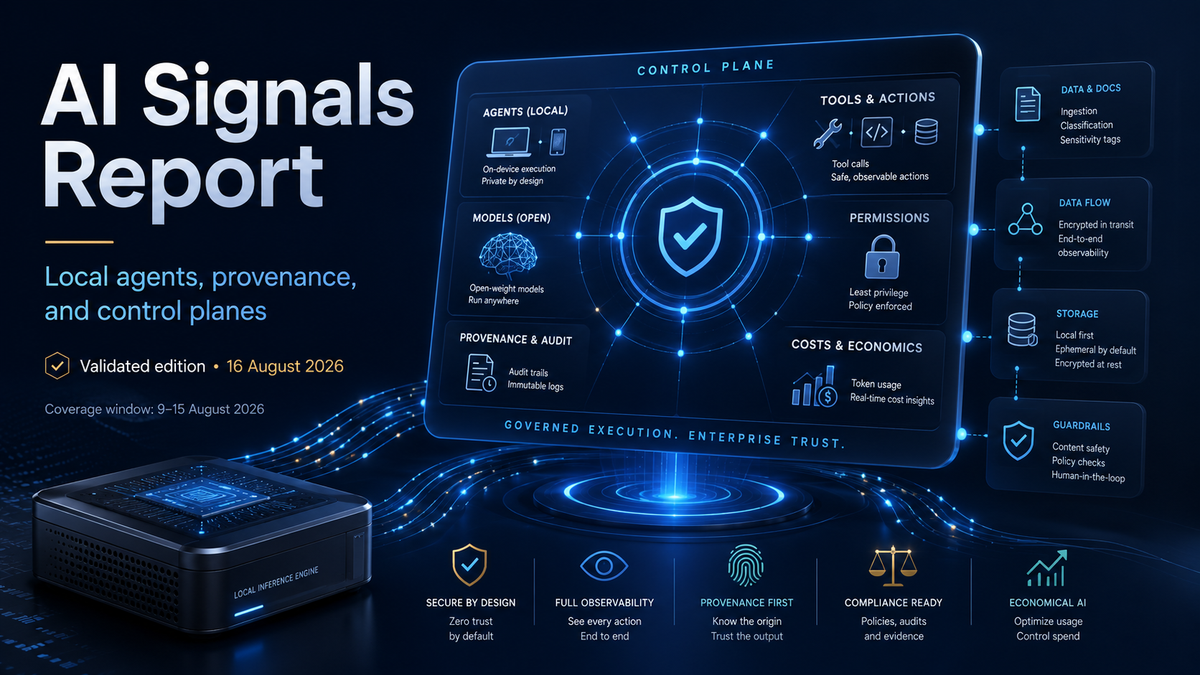
Coverage window: 9–15 August 2026
At a glance
- Local agents need guardrails: Meta's Muse Glimmer is a 30B dense, open-weight model designed for always-on local agent workflows. NVIDIA shows fully on-device deployment on a single 32GB-class GPU, making local execution increasingly practical; the hard enterprise problem is now authorization, memory, telemetry, rollback, and evidence.
- Open weights keep scaling: Qwen3.8-2.4T-A95B combines 2.4T total parameters, about 95B active parameters, and a 262K native context extensible to roughly 1M tokens — with downloadable weights. At the smaller end, Apertus Mini shows how distillation and quantization can turn a sovereign open model into 16 compact variants for constrained hardware.
- Hosted models reset economics: Gemini 3.7 Flash launched on 13 August with introductory pricing reported at $0.75/M input tokens and $3.75/M output tokens through 2026. Grok 4.6 pairs a 500K-token context with a meaningful long-context price cliff: below 200K prompt tokens, $2/M input and $6/M output; at or above the threshold, $4/M and $12/M — applied to the whole request, not only the overflow.
- Research Radar: recent work on authenticated workflows, adaptive incident-response guardrails, LLM-mediated web vulnerabilities, and agent attack surfaces all converge on intent-bound authorization, least privilege, traceability, and recovery.
- Banking Read: banks should treat agents as a control-plane project before treating them as a model-selection project. Require a written control map covering intent, model, tools, permissions, identity, data access, memory, logging, approvals, evaluation, escalation, rollback, and kill-switch ownership.
7-minute read.
The week's thesis
This week tightens a signal that has been building across enterprise AI: capability is becoming cheaper, more portable, and available across both hosted and self-hosted stacks, but deployment confidence increasingly depends on whether an organization can prove what an agent was authorized to do, what data it could reach, which tools it used, what it actually did, and how the action can be stopped or reversed.
The important shift is from model governance to execution governance. Open weights increase infrastructure control but also transfer more responsibility to the operator. Hosted models reduce operational burden but introduce changing price schedules, context economics, vendor dependencies, and data-boundary questions. In both cases, the model is only one component of the risk surface.
Three threads of evidence
1) Local agents need guardrails
Meta released Muse Glimmer on 10 August as a 30B dense open-weight model optimized for local, long-running agent workflows. NVIDIA's deployment guidance shows it running fully on-device on hardware including a 32GB RTX 5090-class GPU, without model sharding or an external inference endpoint. Quantized builds materially reduce the memory footprint, which is what makes the single-device story credible.
The practical implication is that local execution improves data locality and reduces cloud dependence, but it does not solve authorization, prompt injection, memory leakage, excessive permissions, or weak rollback. In regulated work, these controls need to sit above the model.
Sources: NVIDIA Developer Blog · Muse-Glimmer-30B on Hugging Face
Our take: banks should treat local agents as a control-plane project first and a model choice second.
2) Open weights keep scaling
The strongest scale signal is Qwen3.8-2.4T-A95B, an open-weight MoE release with approximately 2.4T total parameters and 95B active parameters, natively supporting 262,144 tokens of context and extensible to roughly 1M. Two details matter for procurement. First, this downloadable checkpoint is distinct from the hosted Qwen3.8-Max product, which adds vision input, non-thinking mode, and built-in tools — the Qwen3.8 family now has both hosted and open-weight deployment paths. Second, unlike most of Qwen's open family, this release does not ship under Apache 2.0: it carries a custom Qwen3.8-Max License, so legal review should read the actual licence file rather than assume the usual terms.
At the opposite end of the hardware curve, the Swiss Apertus Mini collection — introduced alongside Apertus 1.5 — contains 16 small models created through distillation and quantization, released under Apache 2.0 and explicitly aimed at memory- and compute-constrained deployments.
Sources: Qwen3.8-2.4T-A95B on Hugging Face · Apertus Mini collection · Apertus distillation report (arXiv:2605.29128)
Our take: open weights are no longer only a cost hedge. They are becoming an infrastructure strategy for data locality, hardware control, portability, and operational independence — with the trade-off that the enterprise owns more of the serving and governance burden, licence terms included.
3) Hosted models reset economics
Google launched Gemini 3.7 Flash on 13 August. Launch reporting puts the introductory API price at $0.75 per million input tokens and $3.75 per million output tokens through 2026, half the introductory per-token price of the preceding Flash release. This is introductory pricing, not a permanent market floor.
Grok 4.6 launched in the same week as a long-context model for coding, agents, and knowledge work, with a reported 500K-token context window. The important procurement detail is the long-context threshold: below 200K prompt tokens, reported API pricing is $2/M input, $0.50/M cached input, and $6/M output; at the long-context tier, those rates double to $4/M, $1/M, and $12/M. The higher tier applies to the entire request once the threshold is reached, so a workflow that regularly crosses 200K has a discontinuous cost profile.
Our take: procurement should benchmark cost per completed task, not only cost per token. Context size, cache hit rate, tool calls, retries, agent step count, and price-tier thresholds can dominate the headline rate.
Research radar
The radar is selected on relevance to the week's operating question, not on publication date alone. It is split accordingly: work published inside the coverage window, and older work that this week's releases made newly relevant.
Published this week
From Prompt Injection to Web Exploitation: Revisiting Classic Vulnerabilities in LLM-Integrated Applications (arXiv:2608.10281, 10 August 2026) — LLM-integrated applications inherit classic web vulnerabilities — including injection and authorization failures — while adding model-mediated attack paths, with the model acting as a mediation layer and, in tool-enabled settings, a confused deputy. The right defensive unit is the full application and tool boundary, not the prompt alone. What to watch: authorization before tool execution, session isolation, input boundaries, output handling, and confused-deputy behavior.
Newly relevant
SoK: The Attack Surface of Agentic AI — Tools, and Autonomy (arXiv:2603.22928, March 2026; revised 11 August) — Maps the attack surface introduced by tools, autonomy, delegation, and long-running execution, and proposes metrics and a phased security checklist. The revision landed inside this week's window, and the survey reads differently now that long-running local agents are deployable rather than theoretical. What to watch: least privilege, privilege-escalation paths, observability of multi-step actions, and tested recovery procedures.
Authenticated Workflows: A Systems Approach to Protecting Agentic AI (arXiv:2602.10465, February 2026) — Proposes protecting agentic workflows through authenticated intent and integrity checks across prompts, tools, data, and runtime context. It reads as the research-side counterpart to what Auth0 shipped this week: intent-bound authorization at the tool boundary. Results are author-reported rather than independent production evidence. What to watch: whether cryptographic or policy-enforced validation can be added without making high-frequency agent actions too slow or brittle.
AIR: Improving Agent Safety through Incident Response (arXiv:2602.11749, February 2026) — Treats safety as a living incident-response loop rather than a static release-time policy, turning incidents into updated safety rules that can block unsafe plans before tool invocation. Six months old, and directly applicable the moment an agent runs on a workstation inside a business process. What to watch: policy versioning, regression testing, rollback, and proof that new rules do not create unacceptable false positives.
Control-plane corroboration
Two additional industry signals make the thesis stronger:
Auth0 — "Intent, Not Just Permissions" (11 August): proposes task-bound, ephemeral authorization so an agent receives only the permissions required for a specific user-intended action, then loses them when the task ends.
Databricks — contextual policies (10 August): operationalizes the "lethal trifecta" pattern — private data, untrusted content, and outbound exfiltration — by tracking session context and blocking the action that would complete the dangerous combination.
These are useful because they move the control-plane discussion from abstract governance into concrete enforcement patterns.
Weekly movers
Week of 2026-08-09 → 2026-08-15.
GitHub
firecrawl/anydoc — Rust library that converts Word, PowerPoint, Excel, OpenDocument, RTF, EPUB, CSV, and text-based PDFs into clean GitHub-Flavored Markdown, with bindings for Node.js, Python, and the browser via WebAssembly. Median conversion under 5ms; no OCR, so scanned pages need a separate path.
Who should care: teams building RAG pipelines, ingestion layers, or on-prem document processing that need reliable, multi-format parsing.
ShawnPana/phone-harness — A thin Python harness for letting an LLM control a real iPhone via macOS iPhone Mirroring, using Vision OCR to see and HID-level events to act. No jailbreak or WebDriverAgent required.
Who should care: agent builders working on mobile task automation, tool use, and real-device evaluation loops.
antirez/h3.c — Native MiniMax-H3 inference engine for Apple Silicon written in C and Metal, with prompt-to-video/audio generation and first/last-frame conditioning. Tested on M3 Max and M5 Max.
Who should care: practitioners tracking local/on-device inference and what a single developer can now extract from consumer hardware.
Models
qwen3.8-max-20260803 — new entrant in this week's usage tracking. Hosted alias for Qwen3.8-Max; note that the broader Qwen3.8 family also ships an open-weight path (Qwen3.8-2.4T-A95B).
qwen3.6-35b-a3b-20260415 — new entrant in this week's usage tracking. Open weights under Apache 2.0; roughly 35B total parameters with ~3B active per token, 262K native context.
muse-spark-1.1-20260709 — a usage mover this week rather than a new release: Muse Spark 1.1 was introduced on 9 July 2026 through Meta's Model API, with launch pricing reported around $1.25/M input and $4.25/M output tokens. Not to be confused with Muse Glimmer, Meta's open-weight release covered above.
The banking read
For banks and regulated enterprises, the lead story is not "can we run a local agent?" but "can we prove the agent stayed inside its lane?" Local execution can improve data locality, but the control requirement becomes stricter because the institution owns more of the stack. Hosted models reduce infrastructure work, but price thresholds, context limits, retention terms, and vendor changes become additional dependencies.
A useful control map for one agentic workflow should include:
- Business intent and accountable owner — what the agent is permitted to accomplish, and who owns the risk.
- Model and version — including routing/fallback models and the conditions that trigger them.
- Tools and scopes — explicit allowlists, read/write separation, and least-privilege credentials.
- Identity and delegation — which user authority the agent inherits and for how long.
- Data boundaries — sources, residency, classification, and cross-border constraints.
- Memory and retention — what persists, for how long, and who can retrieve it.
- Telemetry and evidence — prompts, tool calls, decisions, policy checks, outputs, and immutable audit records where required.
- Human approval gates — the actions that must never execute autonomously.
- Evaluation thresholds — safety, accuracy, policy-compliance, and regression criteria before release.
- Escalation, rollback, and kill switch — named ownership, tested procedures, and recovery objectives.
One concrete bank action this week: choose one agentic workflow and run a pre-production "control proof" against it. Demonstrate a legitimate task, a prompt-injection attempt, an excessive-permission request, an untrusted-content → private-data → outbound-action scenario, and a rollback. Do not expand scope until the evidence is reviewable.
Bottom line
AI capability is becoming less scarce; governed execution is becoming the differentiator. The institutions that gain durable value will be the ones that can show what an agent was allowed to do, what it actually did, why it was permitted, what evidence was retained, and how the action can be stopped or reversed.
Question: if the model is now cheap and portable, which part of your control plane still assumes it is scarce, centralized, and passive?