The AI Writing Debate Is About the Wrong Thing
LinkedIn just added a button to report "AI slop." But the real question isn't whether AI wrote it — it's whether anyone's willing to stand behind what it says.
The AI Writing Debate Is About the Wrong Thing
There is a strange discussion happening around AI-generated writing.
Using AI to write a post, an article, or even an email is increasingly treated by some people as somehow immoral. Not merely bad writing, lazy writing, or inaccurate writing — almost a form of cheating.
Naturally, an entire ecosystem has appeared around this anxiety.
We now have tools designed to detect whether a text was written by AI. And, almost immediately, another category of tools appeared whose purpose is to "humanize" AI-generated text so that those detectors won't recognize it. Detectors and humanizers are, in a sense, the same business — sold twice.
The platforms have joined in. At the end of July, LinkedIn shipped a "seems like AI slop" button, and that signal now feeds into how far a post travels beyond the author's own network. It also retired its own "enhance your post" AI writer in favour of a proofreader. Substack launched detection a week earlier, and Pinterest is labelling generated images.
The numbers behind the panic are not small: Pangram's scans suggest around 40% of long-form LinkedIn posts are fully AI-generated.
The moralists, the technocrats, and the followers
Behind all of this, I see roughly three attitudes emerging.
The moralists want to establish norms around what constitutes acceptable creation. AI-generated content is considered less authentic, less legitimate, less worthy. The danger is that criticism of genuinely low-quality AI content turns into something broader: excluding people based on conformity to an expected way of creating. and the instruments are unreliable: human judgment on whether a text is AI-written is close to a coin toss, and detectors produce both false positives and false negatives at non-negligible rates.
The technocrats go to the opposite extreme. Technology exists, therefore it should be used. If AI can automate something, automate it. If it can replace a job, replace the job. The problem isn’t the ambition — it’s making irreversible decisions against a moving target. What these systems can do changes every few months, and where they fail is still poorly mapped. Cut the people who held the knowledge, and you find out which of the two mattered only once it’s too late to reverse.
And then there are the followers, who want the benefits without the social cost. They use AI, then run the result through humanizers or elaborate prompting rituals to make sure nobody notices. Understandable behaviour — and also the only one of the three positions that requires you to lie.
I don't find any of these particularly satisfying.
What people are actually angry about
Here is the part I think the whole debate misses.
What offends people about "slop" is not that a model was involved. It's that nobody was home. You read something assuming there is a person behind it — an intention, a position, something they wanted you to understand — and there isn't. It's the plagiarism feeling: not "this is badly written," but "I was addressed by no one."
So the real line isn't human-written versus AI-written. It's whether someone did the thinking and is willing to stand behind the result. Those two lines happen to look similar today, which is why we confuse them. They won't stay similar.
AI detectors are a symptom, not the issue
AI detection probably makes sense in some specific contexts. Exams and competitions are obvious examples: if the purpose is to evaluate someone's unaided ability, knowing whether that person actually produced the work matters.
Outside those contexts, our obsession with detection is mostly a symptom of the transition we're going through. As usual, the tool gets all the attention because the underlying change is much harder to deal with.
The change, however, has already happened.
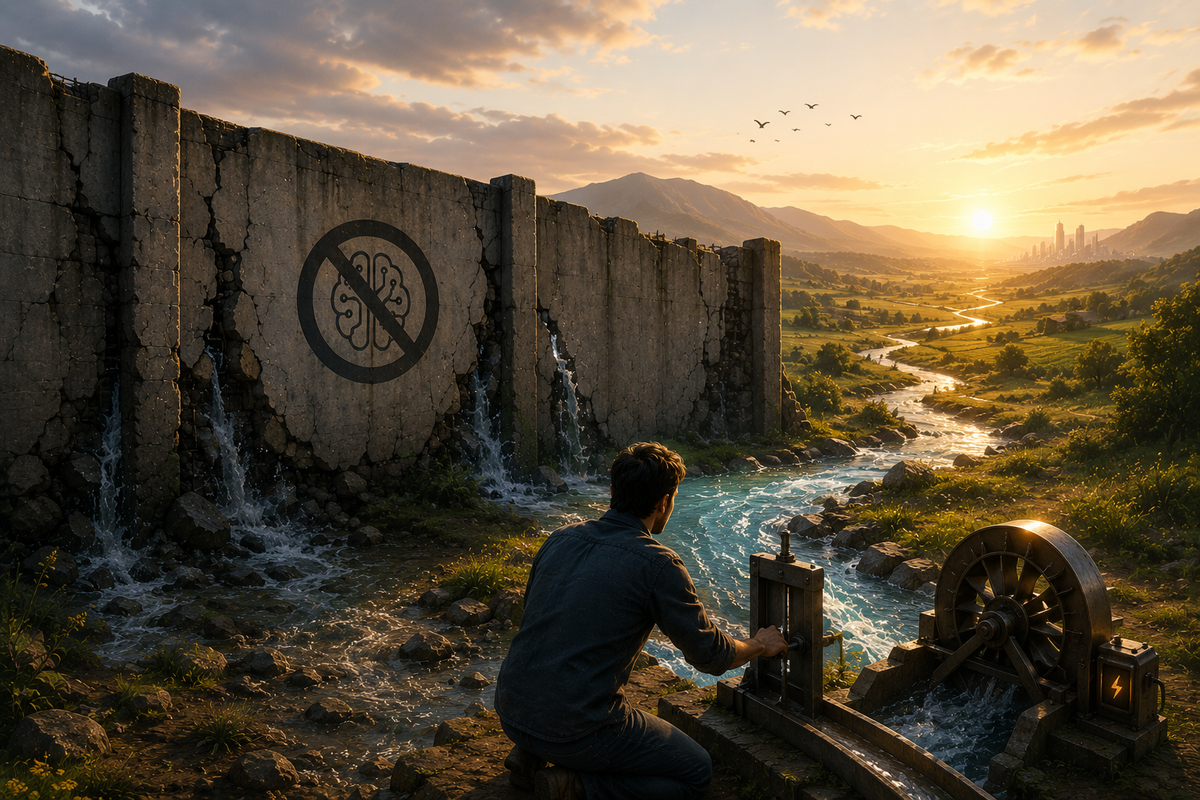
The time when articles, posts and even books were written exclusively by humans is disappearing. Trying to prevent that feels like trying to stop rising water by building a wall. It works for a while. Then the water starts flowing around it. Eventually, the wall becomes irrelevant.
The more interesting question is therefore not "how do we stop people from using AI?"
It is: "how do we use AI in the most effective and creative way possible?"
Developers have already been through this
I have been a developer since I was 12, which gives me an interesting perspective on this transition.
Developers were among the first professions forced to confront a particularly uncomfortable version of the AI question: what happens when AI can write what I write — faster and, quite often, better?
And yes, everything changed.
I don't write code the way I did before AI. Why would I?
For developers who embraced these tools, the result isn't that there is suddenly nothing left to do. It's that we deliver more, faster, while spending more of our time on the parts that actually matter. What feature are we trying to build? What does the user really need? Does our implementation solve the right problem?
Meanwhile, the mechanical work can increasingly be delegated: learning the syntax of yet another framework, writing boilerplate, configuring environments, digging through endless log files, hunting a trivial bug for hours.
Those things used to consume an enormous amount of development time. I don't particularly miss them.
The value of the developer moves upward — from producing code toward deciding what should be produced and why. That is, globally, a positive change.
And I think something similar is about to happen to writing.
Yes, my articles are written with AI
So I will continue using AI whenever I can.
My code uses AI. My posts use AI. My articles use AI.
Not because I have nothing to say, but precisely because I do.
AI helps me produce what I want to produce. It helps me articulate ideas I think are worth discussing, find information quickly, challenge an argument, restructure something that isn't clear, and turn an idea into something I can actually publish.
The interesting question for me isn't whether every individual sentence originated inside my brain and was typed manually on a keyboard. The interesting question is whether the ideas are mine, whether I stand behind them, and whether what I publish is worth your time.
And no, I won't run the result through a "humanizer." The idea of asking one AI to rewrite the output of another AI so that a third AI believes a human wrote it seems like a particularly absurd use of everyone's time. It's also the one tool in this whole stack whose entire value proposition is the lie.
If something I publish is bad, criticize it because it's bad.
If it's wrong, tell me it's wrong.
If it's boring, don't read it.
But if it's useful, interesting, or makes you think — does it really matter what percentage of the keystrokes came directly from me?
My one concession to the anti-AI moralists is that, for now, I probably won't put "AI slop producer" in my LinkedIn profile description.
Although perhaps I should. It might help this transition happen a little faster.
So let me ask you directly: in your organisation today, is the real rule "don't use AI," "use it and don't say so," or "use it and say so"? And which one are people actually following?