Langchain
this training is based on a Udemy course titled "ChatGPT and LangChain: The Complete Developer's Masterclass," which has a duration of 12 hours. For those interested in taking the course, it's important to note that while the content is very interesting, it contains some outdated concepts. Additionally, it doesn't explain how to expose the language model (LLM) through APIs. I will ensure to supplement the information with updated guidance whenever possible. Also, we will specifically focus on exposing the LLM through an API using FastAPI. I will modify the tutorials to connect to the Azure OpenAI service, which is our internal goal. Additionally, we will utilize PostgreSQL as the vector database instead of ChromaDB and Pinecone.
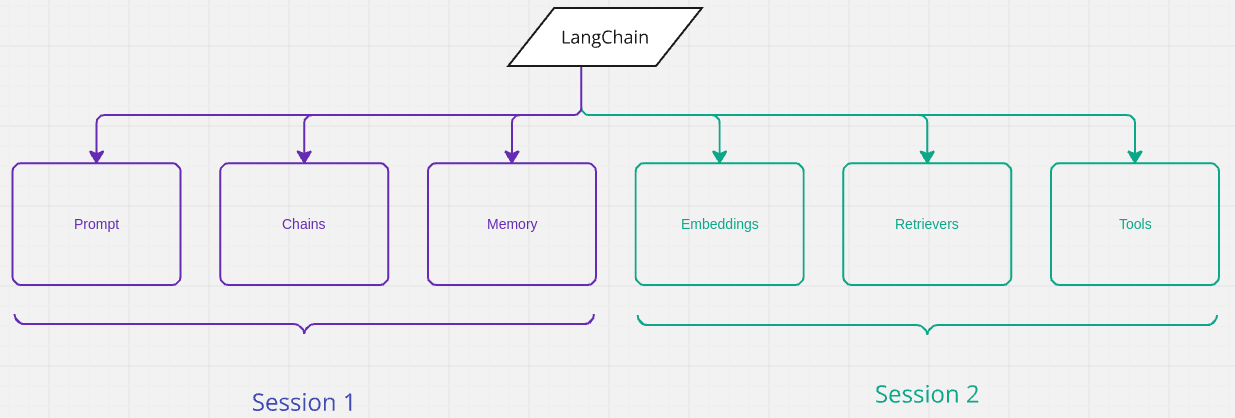
In this tutorial, we aim to break down and enhance a program by leveraging the LangChain library and its integration with the OpenAI API. By the conclusion of this tutorial, you'll have learned the essentials of setting up a LangChain-powered application and the foundational concepts that make this integration both flexible and powerful. We'll talk about everything shown in Picture 1.
Finally, all the code and examples can be available in the github repository as Jupyter notebooks. Happy coding!
What is LangChainLangChain is a tool that helps make apps using really smart AI like GPT-4. It's free and helps combine different tools to create useful stuff. Developers can use it with other data and tools, and it works with Python and JavaScript programming languages. Here's a simple example of how it works: Imagine you're asking the AI model a question, like "What's the capital of France? LangChain converts your question into a type of code that can be searched in a special database. It finds the most relevant information from this database, and then gives it back to the AI model. The AI model then uses this information to give you the correct answer, which is Paris.
LangChain also helps automate things to make processes easier. For instance, say you want to make an app that tells jokes. With LangChain, you can use an AI model to find and tell a different joke every time someone asks for one!
Langchain key concepts- Components: Think of these like LEGO pieces that you can easily snap together to make cool stuff. Some examples are :
- LLM Wrappers: Like a special box that helps AI models work better.
- Prompt Template: Pre-made question patterns to ask the AI.
- Indexes: Helps the AI quickly find important information.
- Chains: Imagine linking several LEGO pieces together to build something bigger. Chains let you connect different components to do a job. This
makes it easier to build and fix big projects, as you can just adjust or swap one part without affecting the whole thing. - Agents: These are like smart robots that can use tools around them. For example, an agent can look up stuff on the internet or use a special
service to complete a task
Don't worry if you can't remember everything right now. We'll review all these concepts later
Training content
https://ai-signals-report.ghost.io/content/files/2026/06/langchain-prompts.html https://ai-signals-report.ghost.io/content/files/2026/06/langchain-chains.html https://ai-signals-report.ghost.io/content/files/2026/06/harry-potter-and-the-magical-embeddings.html