One Line in Shanghai: What Xi's AI Speech Tells European Banks Betting on Chinese Open Models
Xi Jinping's WAIC 2026 keynote gave open-source AI exactly one sentence — and closed on being ready to change course. If your bank is building on Chinese open-weight models, that ratio is the strategy question. Part 1 of 3.
This is Part 1 of a three-part series on whether relying on Chinese open-weight models is a sound strategy for European and Swiss banks. Part 2 will look at what China's regulatory machinery bakes into the weights. Part 3 will lay out the decision framework for a bank.
Audio
Prefer to listen? 13 min, full narration.
The most important sentence in Xi Jinping's biggest AI speech to date is not the one about open source.
It's the one about staying ready to change course.
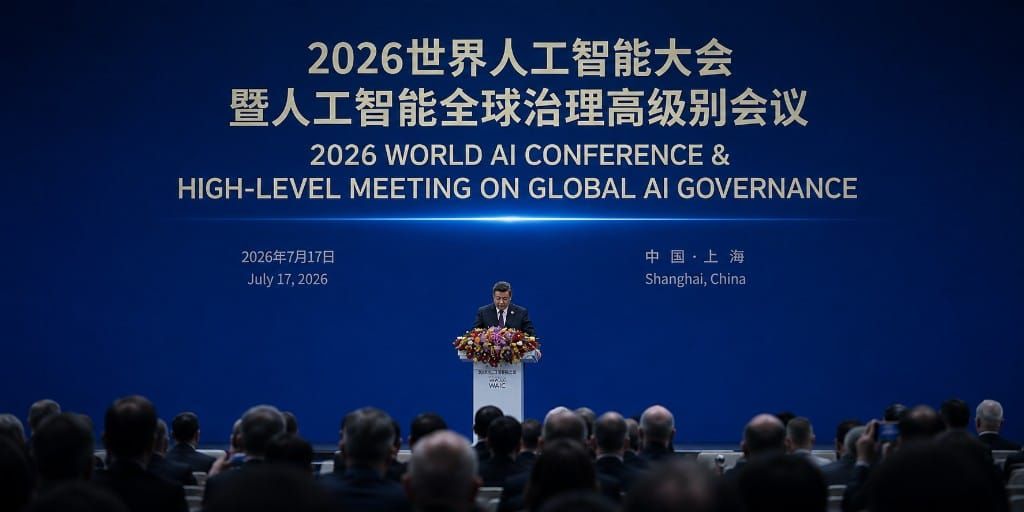
On 17 July, Xi gave the keynote at the World AI Conference in Shanghai — the first time he attended WAIC in person, which in the Chinese system is itself a message. The timing sharpened it: that same day, the UK's AI Security Institute reported that the gap between Chinese and leading US models has narrowed faster than expected — from six to ten months in 2025 to as little as four months now. This is no longer a story about a cheap alternative. It's a story about a near-peer.
If you run technology at a European or Swiss bank, you may be tempted to file the speech under "diplomacy, not my problem." I'd argue the opposite. If DeepSeek, Qwen or Kimi are anywhere in your architecture — or in your on-prem roadmap, as they are in ours — this speech is a supplier communication. It deserves the same reading you'd give a critical vendor's strategy update.
Here's what I took from it.
Open source got exactly one line
The line everyone in AI policy was waiting for came and went in a single clause: China should encourage open source, openness, collaboration and sharing.
That's it. One mention, in a speech of roughly 2,000 words.
Matt Sheehan, who annotated the full speech, reads it the way I do: this is a restatement of the status quo — nearly identical language appeared in the 2023 Global AI Governance Initiative. It is not a pledge about future policy. And as Sheehan points out, that's mildly surprising. Open-weight models are China's single biggest selling point on the global stage right now. Large parts of this speech were a direct pitch to developing countries and international business. If Beijing were locked in on open-weighting its frontier models indefinitely, you'd expect a stronger endorsement — not a line you could delete without changing the speech.
The speech is a pitch — and your bank is part of the audience
Read as a whole, the keynote is China's three-year-old sales narrative, delivered at its highest level yet: we are the open, cooperative partner — implicitly contrasted with an America that restricts and excludes. Capacity building for the Global South. A new World AI Cooperation Organization, headquartered in Shanghai. Five thousand AI training places for developing countries. Cooperation centers with ASEAN, the African Union, BRICS.
Open-weight models are the load-bearing wall of that pitch. Every European bank that standardizes on a Chinese model is, from Beijing's perspective, evidence that the pitch works. That doesn't make the models bad — they're excellent, and the economics are real. It means the supply of them is not a market fact. It's a policy instrument.
One precision worth insisting on, because it gets blurred constantly: what China ships is open-weight, not open-source. You get the weights. You generally don't get the training data, the full training code, or anything that would satisfy the Open Source Initiative's definition. Some licenses are genuinely permissive; others carry custom terms your legal team should actually read. "Open source" is doing marketing work in that sentence — for everyone involved.
AI-pilled, not AGI-pilled — and why that's quietly reassuring
Now the counterweight, because this analysis shouldn't read as a scare piece. Understanding what China actually wants from AI changes the risk picture — mostly for the better.
Kyle Chan of Brookings, on the FT's Economics Show, describes Beijing as thoroughly convinced AI is transformative — but not chasing an intelligence explosion. There is no digital god in the Chinese plan. The goal is diffusion: pushing AI into factories, hospitals, robotics, logistics — humanoid robots already testing batteries at CATL plants — making the whole economy incrementally more productive. The "AI Plus" initiative Xi referenced in the speech is exactly that: adoption as the win condition, not AGI.
And the labs themselves? Private companies, fighting first and foremost for the enormous Chinese domestic market. International users are, for now, largely a credibility play — the open-weight strategy exists to get the world to take their models seriously and start integrating them. The US market is the final frontier, not the main event. Meanwhile, Beijing's policy circles watch America pour projected trillion-dollar sums into data centers on what amounts to a leveraged bet on AGI — and, per Chan, mostly scratch their heads.
Here's why this matters for a bank: a supplier ecosystem optimizing for deployment — cheap, efficient, practical models that run well on constrained hardware — is optimizing for exactly what an enterprise needs. Those incentives are legible and stable. Contrast that with a US ecosystem whose economics depend on an AGI outcome materializing, and whose politics increasingly frame AI as a civilizational contest. Pragmatism, whatever else you think of it, is predictable. In vendor risk terms, predictability is a feature.
But hold that thought, because pragmatism cuts both ways: a state that treats AI as industrial policy will treat model supply as industrial policy too. Which brings us to the end of the speech.
The ending is the tell
Xi closes the speech with a classical quotation about the wise adapting to changing circumstances — and then a dense sentence on how the faster AI advances, the more precisely regulation must be calibrated and the more promptly measures against loss of control must be refined.
Sheehan flags this as notably stronger language than the usual "agile governance" boilerplate. And "loss of control" (失控) is a deliberately elastic term in Chinese policy discourse — sometimes it means loss of human control in the AI-safety sense, sometimes loss of state control over the technology stack, sometimes industrial systems going awry. The ambiguity is not sloppiness. It's optionality.
So the structure of the speech, seen from a bank's risk desk, is this: one soft line sustaining the open-weight status quo, and a closing passage reserving — emphatically — the right to tighten. In China's system, Xi's words are not commentary; they're ammunition. Regulators, ministries and standards bodies will spend the next year attaching their agendas to these exact phrases. (How that machinery converts words into binding rules is Part 2 — it's more scandal-driven and more fast-moving than most Europeans assume.)
Three hands on the same valve
And the tightening is not hypothetical. Listen to what's moving right now, ten days after the speech:
🏛️ Security. The FT has reported that China's Ministry of Commerce is considering export controls on its own AI technology — the country that spent years on the receiving end of chip restrictions is studying how to impose its own. On the same Economics Show episode, Chan described early policy discussions in Beijing about whether sensitive Chinese data could be extracted from published model weights themselves. The options being discussed range from limiting open releases to restricting who can access them — with the caveat, as Chan stresses, that it's early and much is unknown.
💰 Commerce. The labs have their own reasons to close up. They've spent heavily on training and infrastructure, several have gone or are going public, and open weights don't pay for data centers. Chan sees a hybrid emerging: keep the open-source halo, monetize through APIs and subscriptions. Remember: their primary market is domestic. If serving foreign downloaders ever becomes more trouble than the credibility is worth, the commercial gravity points the same way as the security concerns.
🤝 Geopolitics. US and Chinese policymakers meet in September, with AI on the agenda — and one plausible American ask is precisely that Beijing tighten control over its open models. Your model supply could become a line item in a trade negotiation neither side runs for your benefit.
Three independent forces — state security, lab economics, great-power bargaining — all pressing on the same valve. What holds it open today is, in large part, that one line in Xi's speech.
What this means if you're building on Chinese weights
Let me be clear about what I'm not saying. I'm not saying Chinese models are a trap, and I'm not saying a model running on your own GPUs phones home to Beijing — it doesn't; that's precisely why we run open weights on-premise. Cost and control are exactly why serious enterprises everywhere — including, as Chan notes, in the US — are adopting these models: you keep your data, you fine-tune on your own terms, and you don't hand a nine-figure invoice to an API provider. That argument is largely sound, and I'll defend it in Part 3.
The real question is different. It's not "Is Qwen good enough for our use cases?" — today, honestly, it often is. Nor is it "Is Beijing coming for our data?" — the pragmatic, diffusion-first strategy above is genuinely more reassuring than the caricature.
It's closer to: "Am I comfortable making a core capability dependent on a supply line that three separate forces are already pushing to narrow — and whose continuation is one sentence in a speech, delivered by a government that used its closing lines to tell me it reserves the right to change course?"
That's a concentration-risk question, not a model-quality question. And concentration risk is something banks, of all institutions, know how to price.
Bottom line: the next phase of enterprise AI in European banking won't be won by whoever picks the best model this quarter. It'll be won by whoever treats model supply as a dependency with policy risk attached — and architects so that any single model, Chinese, American or European, is a component they can swap, not a foundation they're stuck on.
How swappable is your stack, honestly? If open-weight releases from China tightened next year, would replacing your model take you weeks — or years?
Sources: Xi Jinping's keynote at WAIC 2026, full text (MFA) · Matt Sheehan's annotated translation and analysis · FT on China AI export controls · FT, The Economics Show: China's AI race, with Kyle Chan (Brookings), July 2026 · Carnegie: Tracing the Roots of China's AI Regulations