Stop Waiting: This Is the Best Time to Hire Junior Talent.
The market stopped hiring juniors because of AI — entry-level postings are down 32% in Switzerland alone. The data says that's the wrong conclusion, and the firms that see it have a rare window.
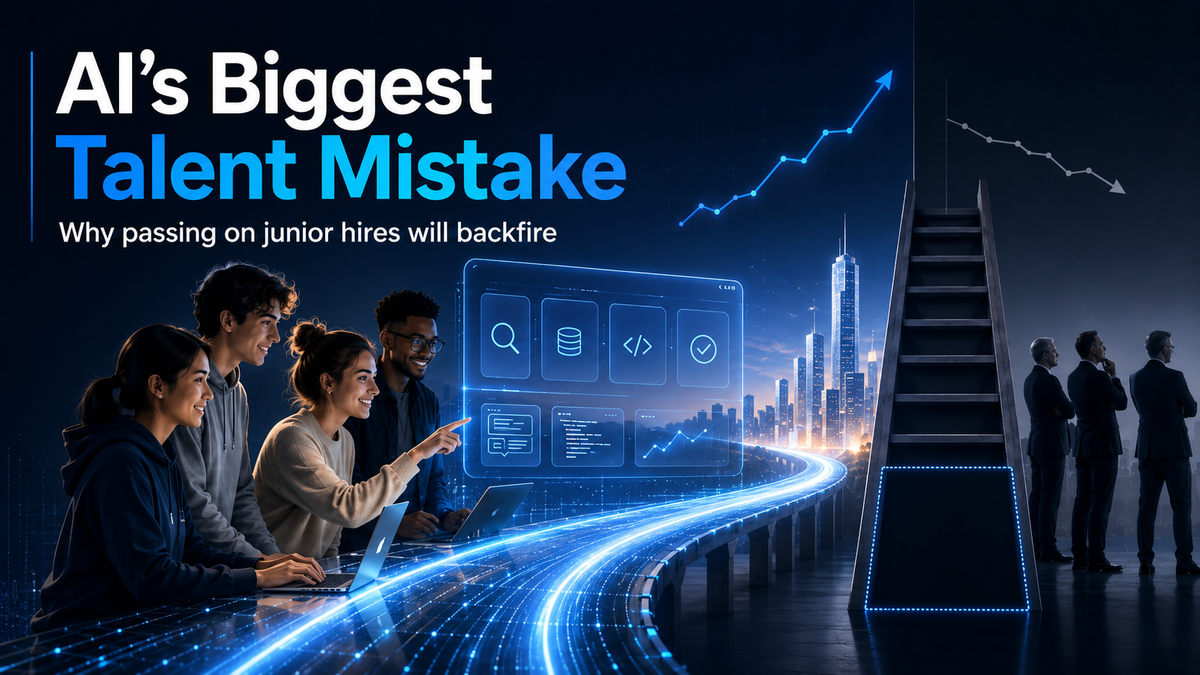
Everyone reads the youth-employment data as a warning. I read it as an opportunity — maybe the clearest one in the talent market right now.
Let me show you the numbers first, because they're genuinely striking. Then let me tell you why I think most of the market is drawing exactly the wrong conclusion from them.
What the data actually says
Stanford researchers tracked millions of US payroll records to isolate AI's effect on employment. Their finding, in the "Canaries in the Coal Mine" study: since late 2022, employment for 22–25-year-olds in the most AI-exposed occupations has fallen roughly 13% — while older workers in the same occupations were largely untouched. The Stanford AI Index adds a sharper cut: employment for software developers aged 22–25 is down nearly 20% from its 2024 peak.
Meanwhile, aggregate unemployment hasn't moved. Anthropic's own economists, the IMF, and Stanford — different data, different methods — all land on the same result: no detectable aggregate effect. The disruption isn't spread across the economy. It's concentrated on one group: people at the start of their careers, in exactly the sectors we work in.
And this isn't an American story. In Switzerland, jobs.ch's first AI Report — 7.3 million job postings analyzed, published in June — found the share of entry-level postings down 32% versus the pre-AI average, with the steepest declines exactly where you'd expect: banking, finance, administration, and IT. Junior openings shrinking, senior openings growing. The same scissors, closing on the same cohort, in our own market.
The market's conclusion has been brutally simple: AI does what juniors used to do, so stop hiring juniors.
I think that conclusion will look like one of the great talent-strategy mistakes of the decade. Three reasons.
Reason one: nobody understands AI yet — and juniors are built for that
Here's an uncomfortable admission from someone who runs an AI team for a living: we do not really understand this technology yet. Not fully. The models change every quarter. The techniques that worked in January are superseded by June. Anyone who tells you they have a settled playbook for AI in the enterprise is describing last year's landscape.
What actually works right now is disciplined, continuous experimentation. Try, measure, discard, try again.
And experimentation is a junior's native mode. Seniors — and I say this as one — optimize what we already know. Our experience is an asset until the ground shifts, at which point some of it becomes inertia. Juniors have no legacy playbook to defend — and more than that, they see AI mastery as their differentiator, the one advantage they hold over everyone with twenty years of experience. So they don't approach the technology defensively; they run at it. In an environment where the half-life of best practice is measured in months, that combination — nothing to protect, everything to gain — stops being a weakness and starts being an edge.
To be clear: the seniors who make the same move — folding AI into deep expertise — are the most valuable people in any organization right now. There just aren't enough of them, and you can't buy more. You can only grow them.
Reason two: the pressure is forging exactly the workers you want
The cohort being squeezed hardest is, predictably, adapting fastest. Handshake's data shows Class of 2026 CVs mention AI skills more than nine times as often as the Class of 2022. These aren't students who added a buzzword — this is a generation that watched the first rung of the ladder wobble and responded by teaching themselves the tools, often faster than universities could update curricula.
Difficult markets don't produce entitled hires. They produce adaptable ones. The juniors reaching your desk in 2026 have already internalized something many senior professionals still resist: that continuous relearning is now the job, not an interruption to it. You are not hiring them despite the disruption. You're hiring people who were shaped by it.
Reason three: AI is about to manage processes — and you need to grow the humans inside them
This is the argument I find most important, and the one I see almost nobody making.
The next phase of enterprise AI isn't a better copilot. It's agentic systems orchestrating entire workflows — AI as a process manager, sequencing work, routing tasks, escalating exceptions. In banking IT, the early versions of this are already being built.
When that arrives, the critical question becomes: who are the humans inside those processes? Who supervises the agents, catches the failure the system can't see, carries the judgement the workflow depends on?
You cannot hire that person ready-made in 2030. That person has to grow up alongside these systems — learning the domain while the agentic layer is being built, developing judgement about where the automation breaks precisely because they were there when it was assembled. The people you onboard now will be the human core of your AI-managed operations in five years. Skip this cohort, and in 2030 you'll be running agentic processes with no one who deeply understands either the process or the agents.
The bet the market is quietly making
The firms that stopped hiring juniors haven't eliminated their need for senior talent in 2031. They've simply made an unexamined bet: that when the time comes, they'll buy ready-made seniors on the open market — from a pipeline nobody funded.
That's not a strategy. That's hoping someone else pays for your training.
And here's the thing about that bet: it fails collectively. If everyone skips the juniors, the 2031 seniors don't exist. The firms hiring young people now — while they're available, motivated, and priced by a pessimistic market — are the ones who'll own the scarcest asset of the next decade: experienced people who are fluent in both the domain and the agentic systems running it. And guess what: that profile is exactly the scarcest asset today. Every firm currently fighting to hire people who combine deep domain knowledge with real AI fluency is paying the price of a pipeline nobody built five years ago. We know how this movie ends — because we're living in the previous ending.
The bottom line
The next talent war won't be won by whoever pays most for senior engineers in 2030. It'll be won by whoever hired the juniors everyone else passed on — while they were still available.
I work with a lot of developers starting to use AI at scale, including many at the start of their careers. The pattern I see week after week: the people who move fastest aren't the ones with the longest CVs. They're the ones who can integrate each new technology into their existing work and keep building — what Quincy Jones did in music for five decades, from big bands to synthesizers to hip-hop, absorbing every new wave without ever losing the craft. That's the trait to hire for. It isn't about age. But right now, an entire generation showing it is sitting on the market — waiting for someone to notice.
So the question I'd put to every IT and business leader reading this: are you hiring juniors right now — or waiting for the market to tell you it's safe?
Sources: Brynjolfsson, Chandar & Chen, "Canaries in the Coal Mine?" — Stanford Digital Economy Lab · Stanford AI Index · Massenkoff & McCrory, "Labor Market Impacts of AI" — Anthropic, March 2026 · jobs.ch AI Report 2026 (via ICTjournal) · PwC Global AI Jobs Barometer 2026 · NACE Job Outlook 2026 Spring Update · Handshake / entry-level statistics roundup