Your Bankers Are Ready. Your Bank Isn't.
Microsoft's Work Trend Index and Anthropic's Economic Index — two unrelated datasets — point at the same conclusion: AI value in banking is decided by the operating model, not the tooling. Here's what that means for corebanking.

The next phase of AI in banking may not be decided by which bank has the best models or the most licenses. It may be decided by which bank rebuilds its operating model first — and for once, the evidence doesn't come from one vendor. Two independent datasets, measuring completely different things, now tell the same story.
The big picture: the agency equation
Two very different sources frame this year's evidence. Microsoft's 2026 Work Trend Index draws on trillions of anonymized Microsoft 365 signals plus a survey of 20,000 AI users across 10 countries. Anthropic's Economic Index takes the opposite approach: no surveys — privacy-preserving analysis of a million real Claude conversations. One measures what people report and what their office tools log; the other measures what people actually do with AI. Where both point the same way, it's worth listening.
Microsoft opens with what it calls the new agency equation: as agents take on more of the execution, humans get more agency. More room to direct the work, make the calls, own the outcomes.
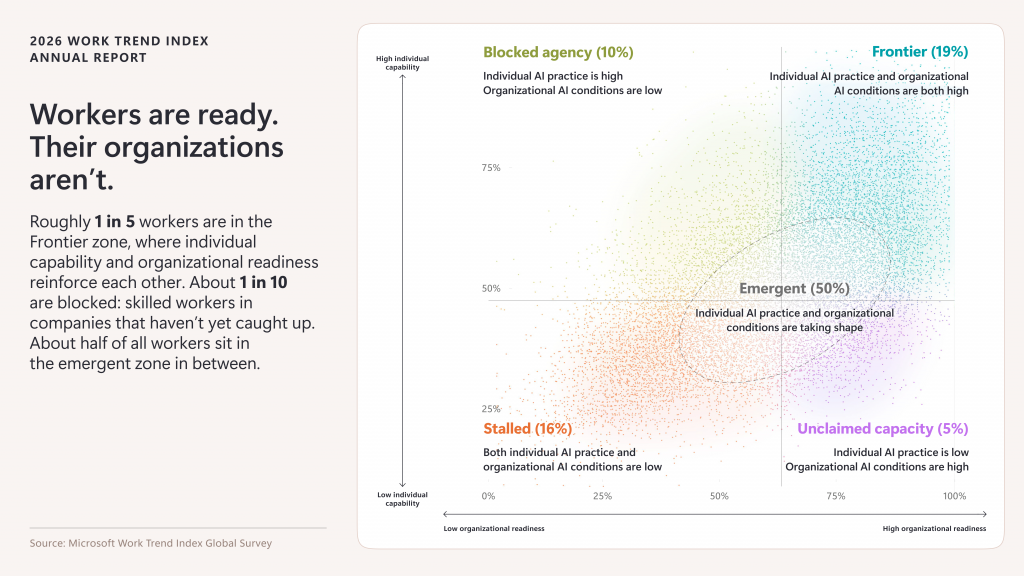
But its central finding is less comfortable. A growing share of workers are already using AI in advanced, resourceful ways — and most organizations aren't keeping up. In Microsoft's words: people are ready, the systems around them are not. The constraint isn't the technology or the talent. It's the gap between what employees can now do and what their organizations are built to support.
If you work in banking technology, that sentence should feel familiar. We've spent a decade saying our constraint was legacy systems. The 2026 data suggests something sharper: the constraint is legacy operating models — and the two are not the same thing.
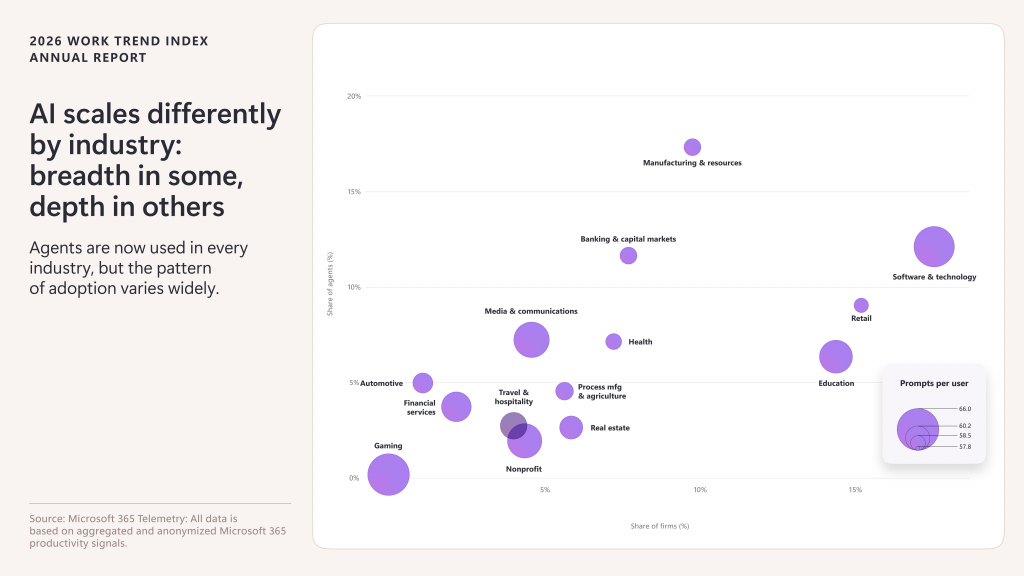
Microsoft's agent telemetry shows where banking stands. On breadth — how many firms are actually deploying agents — banking & capital markets trails software and technology by a wide margin. The firms that have moved go deep: heavy agent usage, embedded in real workflows. But they are a minority. The industry picture isn't a wave, it's a split — a few banks compounding an advantage every quarter, and most still watching.
Anthropic's data confirms both halves of that split. On the moving side: among the workflows whose share of API traffic at least doubled in three months was automated trading and market operations — monitoring positions, reading market conditions, proposing trades. Note where that work sits: the capital-markets side. The part of finance that was already algorithmic twenty years ago is the part now automating with agents. Which is the real story — the split isn't only between banks, it's inside them. Trading floors move. Settlement, payments, onboarding, the corebanking core: those wait. Same institution. Same budget. Same access to the same models.
On the watching side: AI use overall is getting more concentrated, not more evenly spread — a narrowing set of tasks and places accounts for a growing share of all usage. Adoption isn't diffusing across the industry. It's deepening where it already started.
AI value: the biggest factor isn't individual. It's organizational.
So why do most banks sit on the watching side? It has very little to do with technology.
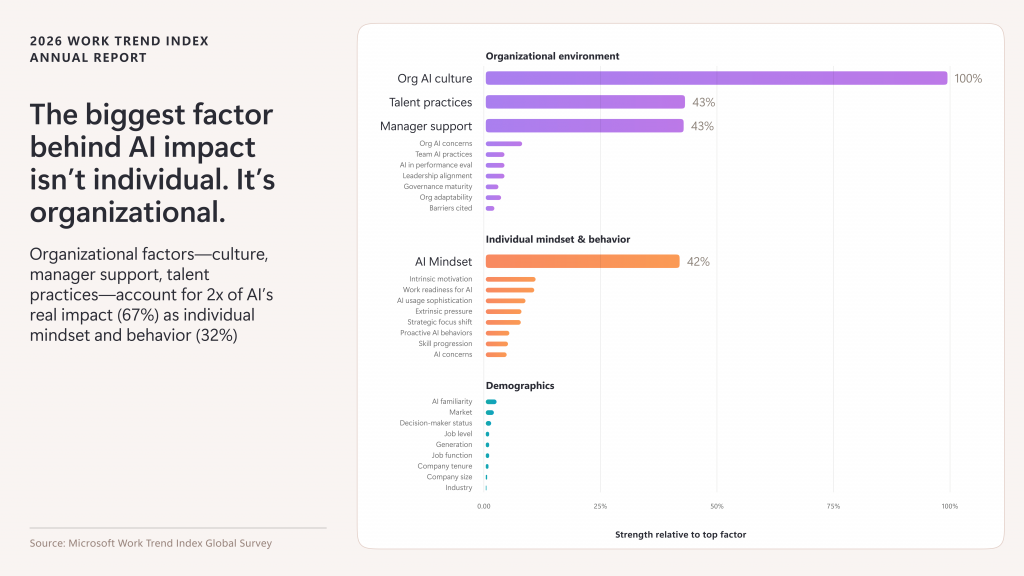
The number that matters most in the whole Work Trend Index: organizational factors — culture, manager support, talent practices — account for more than 2x the reported AI impact of individual mindset and behavior (67% vs. 32%). The strongest single factor, the organization's AI culture, is roughly two and a half times as strong a signal as the top individual factor.
Read that against how most banks have run their AI programs. The default playbook has been individual: buy licenses, run prompt training, track adoption dashboards, hope value emerges. The data says that playbook attacks the 32%, not the 67%.
And there's a second, quieter way to lose the 67%: standing still. The current AI and cloud landscape hands out reasons to wait faster than anyone can act on them — models that change every quarter, cloud versus on-prem trade-offs, sovereignty debates, regulation still being written. Wait for the group strategy. Wait for legal. Wait for the vendor roadmap to stabilize. Wait for someone else to sign. In an industry where careers end over wrong decisions and almost never over slow ones, paralysis is always the rational personal choice — and a costly collective one.
That's exactly why a manager with a vision is worth so much right now. Not the one with perfect answers — nobody has those in 2026 — but the one who picks a defensible path, sets the guardrails, and moves, instead of waiting for validations that will never come, because everyone up the chain is just as frightened of owning the wrong call. In an environment built for hesitation, choosing a direction is itself the competitive act.
What I see daily confirms it. Two developers with identical skills and identical tools diverge completely based on their environment. One sits in a team where the manager uses AI openly, where quality standards for AI-assisted code exist, where experimenting with an agent is encouraged. The other sits in a team where AI is seen as the newest trending gadget — something to demo, not something to build with. Same tools. Same training. Completely different outcomes.
Microsoft's manager data quantifies the difference: when managers actively model AI use, employees report a 17-point lift in AI value, 22 points in critical thinking about their AI use, and 30 points in trust in agentic AI. In a bank, your team leads and chapter leads are the adoption strategy. Everything else is procurement.
From expertise to agency: who gets to do high-value work
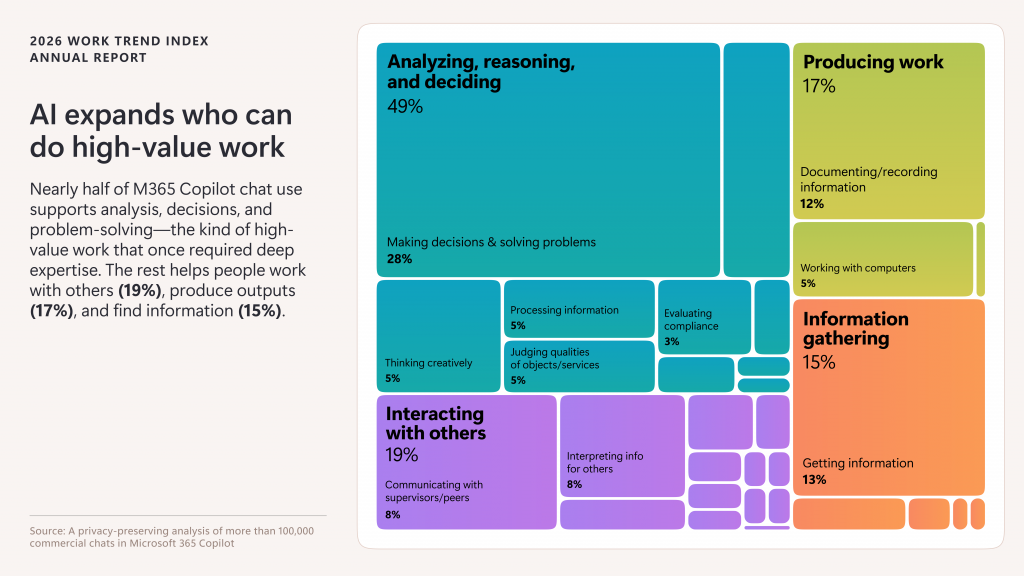
The second finding cuts even closer to corebanking. Analyzing 100,000+ Copilot conversations, Microsoft found that 49% support cognitive work — analysis, problem-solving, evaluation — the kind of high-value work that once required deep expertise. And 58% of AI users say they're producing work they couldn't have a year ago, rising to 80% among the most advanced users. Anthropic's conversation data lands in the same place from the usage side: roughly 49% of jobs have already seen at least a quarter of their tasks performed with Claude. Different vendor, different metric, same conclusion — AI is doing serious work, broadly.
The shift this drives: AI expands who can do high-value work — from expertise to agency.
In corebanking, expertise has always been the bottleneck. The people who truly understand a 20-year-old settlement engine — the batch dependencies, the reasons behind the special cases, why the fix in 2009 was done that way — you can count them on one hand per platform. Every modernization program in the industry has died or crawled on that scarcity.
That gate is lifting. A business analyst with an agent can now read the actual COBOL behind a fee calculation instead of waiting three weeks for the one architect who knows it. A junior developer can trace a payment flow across modules that used to require fifteen years of tribal knowledge. Reverse engineering, impact analysis, functional documentation — the work that made legacy modernization slow and expensive — is exactly the cognitive work AI does best.
But the data carries a warning banks should take seriously: as AI expands what people can do, the premium moves to judgment. The top skills AI users say matter more now are quality control of AI output (50%) and critical thinking (46%) — not prompting, not tooling. Anthropic's data points the same way, and their researchers were surprised by it: they expected the most sophisticated users to automate the most. The opposite was true. The most advanced users iterate — they stay in the loop rather than hand the whole task over.
That matters more in corebanking than almost anywhere, because of how our errors fail. AI-generated code that misunderstands a fee rule doesn't crash. It runs. It passes the tests. It produces numbers that look like numbers. The dangerous output isn't the obviously broken kind — it's the plausible, executable, quietly wrong kind that clears every automated gate and then compounds through a nightly batch into thousands of client positions. Nobody gets paged. A client notices six weeks later, or a regulator does. Detection is expensive, remediation worse, and the incident isn't a bug ticket — it's a letter to FINMA.
Which means the expertise bottleneck doesn't vanish when the gate lifts. It moves. If a junior can now produce in a day the impact analysis that used to take the one architect three weeks, the constraint is no longer producing the analysis — it's validating it. Review capacity doesn't scale just because generation did. A team that adds agents without adding review discipline hasn't removed its bottleneck; it has built a faster way to reach it. Which is an operating-model decision again: who signs off, on what evidence, with what domain knowledge in the room.
There's a longer-term version of the same risk. The scarce architects in every corebanking shop earned that knowledge by grinding through the platform the hard way. If the next generation never does, who is qualified to review the agent's work in 2036? Microsoft's finding that the best users deliberately do some work without AI reads like a personal habit. In a bank sitting on a platform nobody fully understands, it's succession planning.
In this domain, that discipline isn't optional. It's the job.
The Transformation Paradox: where banks sit on the map
The Work Trend Index maps workers on two axes — individual AI capability vs. organizational readiness. Only 19% land in the Frontier zone, where both reinforce each other. 10% are in "blocked agency": skilled people inside organizations that haven't caught up. Half sit in the emergent middle.
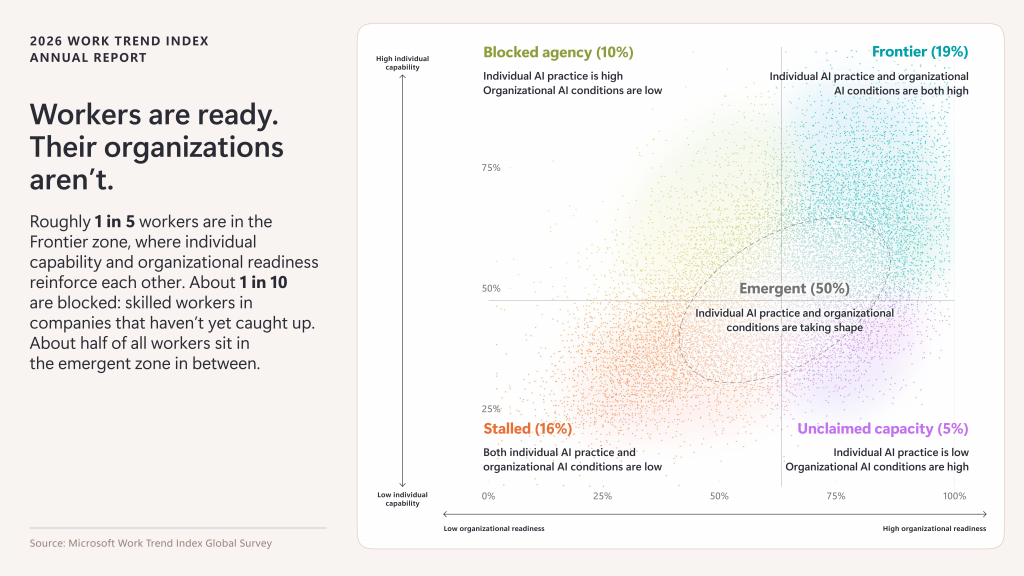
My honest read: banking is over-represented in the blocked zone. Remember the agent chart from the top: depth in a few firms, breadth lagging across the sector. The capability exists. The system resists.
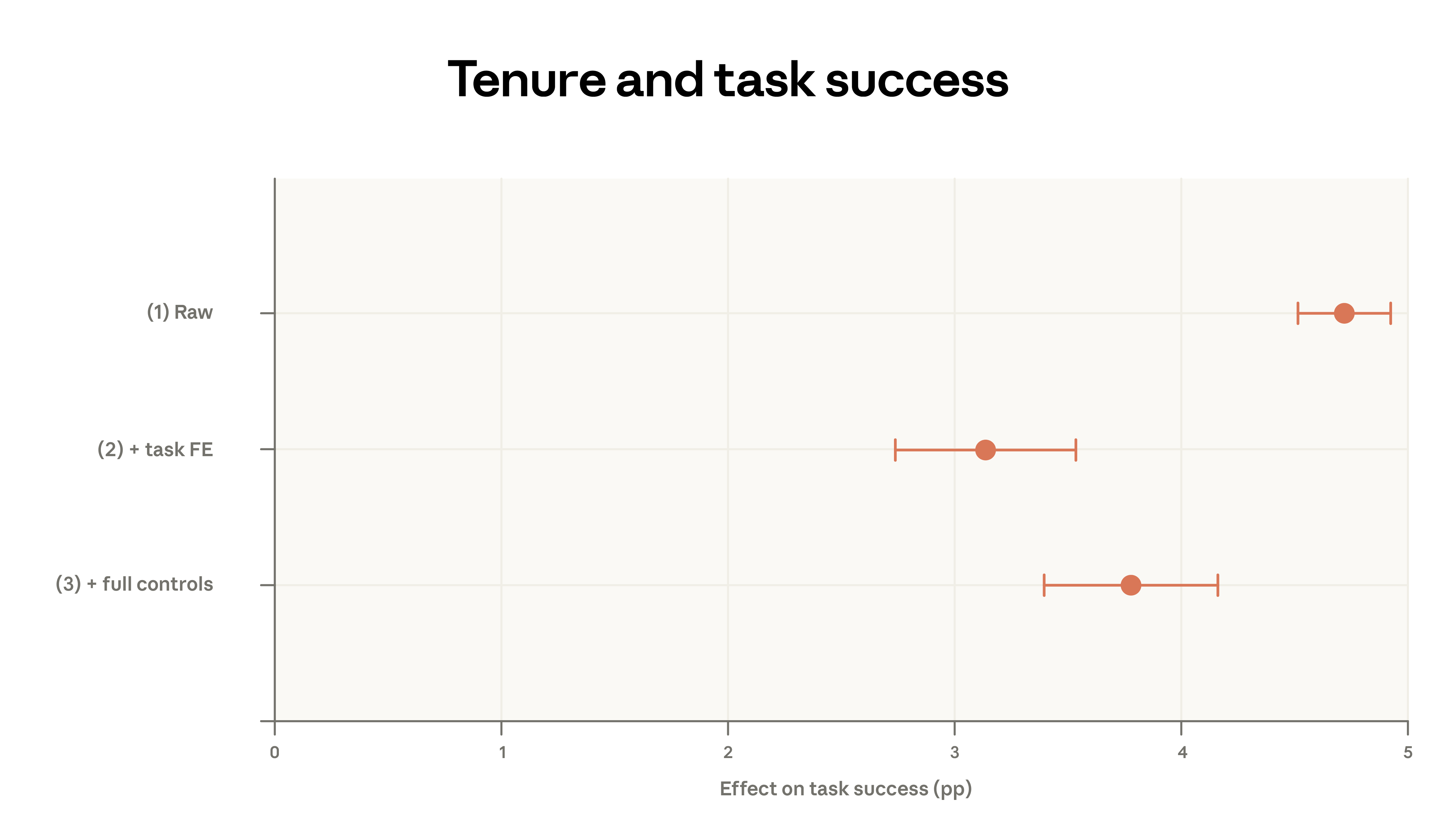
And the delay isn't free, because the advantage compounds at the individual level too. Anthropic's tenure data shows experienced AI users have a roughly 4-point higher success rate per conversation — even after controlling for the task, the model, and the country. Learning-by-doing, measured. Every quarter a bank waits, its competitors' people climb a curve its own people haven't been allowed to start.
The Work Trend Index names why organizations wait, in what it calls the Transformation Paradox: 65% of AI users fear falling behind, yet 45% say it feels safer to focus on current goals than to redesign work with AI. Only 13% are rewarded for reinventing how they work if the results aren't guaranteed. In a bank — zero-defect culture, regulatory scrutiny, incentives built around "the batch ran clean" — those numbers are, if anything, optimistic. We have built institutions where the rational individual choice is to not transform. That's not a people problem. It's a systems problem — and no system has ever redesigned itself.
One more wrinkle from the market data, for readers here in Switzerland: our individuals are ahead of the curve. 18% of Swiss workers qualify as Frontier Professionals against 16% globally, and 65% say they're producing work they couldn't a year ago, versus 58% worldwide. That makes the conclusion sharper, not softer — when the people are above average and the institutions still hesitate, the operating model is even more clearly the bottleneck.
Bottom line
The next phase of AI in banking won't be won by the bank with the most Copilot licenses or even the best models. It'll be won by the bank that treats its operating model — incentives, manager behavior, quality standards, the freedom to redesign a workflow around an agent — as the actual deployment surface. Two unrelated datasets point at the same conclusion: the value sits in the organizational 67%, and the individual learning curve compounds for whoever is allowed to climb it. Most of us are still funding the 32%.
And note what capital markets has already settled. Agents are running in production in the most latency-critical, most regulated, most money-at-stake corner of finance. Whatever "the technology isn't ready for our environment" once meant, it no longer means anything — the proof came from inside the building. The question left isn't whether it works. It's why the rest of the bank is still waiting for permission.
Where does your organization honestly sit on that map — Frontier, emergent, or blocked?